
SUNDAY 1 MARCH 2026
WAGNER’S PAINTER CONTEMPORARIES
A TALK BY MIKE DAY
PRECEDED BY TONY PALMER’S ‘WAGNER’ PART 1
12.00 noon:
DVD – Tony Palmer’s ‘Wagner’ – Part 1 (episodes 1 – 2)
2.00pm:
Talk by Mike Day about Wagner’s painter contemporaries
Venue:
The Goethe Institut
Event Hall (upstairs)
90 Ocean Street (cnr Jersey Road)
Woollahra NSW
Tickets:
$35 members, $45 non-members, $15 full-time students
Program
Photo gallery
Slideshow – photos
Slideshow – video
ABOUT MIKE DAY
Mike Day is Vice President of WSNSW and the editor of the Quarterly. He has been practising as a registered architect for over 50 years and obtained a Masters of Illumination from the University of Sydney in 2004. He taught architectural lighting design and theatre design at UTS Architecture 2003 – 2020. He was a founding designer for Sydney’s Vivid Light Festival in 2009. He has worked as a set designer in several countries, including designing a Don Giovanni with Sir Roger Norrington in London in 1972. He decided to become an architect after his father showed him Utzon’s winning entry for the SOH competition in 1956. Around the same time, he was infected with the Wagner virus when a friend’s mother played him the finale of Die Walküre Act I on an old 78rpm record. He first visited Bayreuth in 1970 and has attended 3 festivals since then. He considers himself very fortunate to have seen some wonderful Wagner performances in the 70’s with Sir Colin Davis, Karl Böhm, Sir Georg Solti and Sir Reginald Goodall.
ABOUT MIKE’S TALK ON WAGNER’S PAINTER CONTEMPORARIES
Wagner had enormous influence on a wide range of composers, thinkers, writers and artists during, and long after, his lifetime. His gatherings at Wahnfried attracted many of the most influential people of the age. Performances of his works generated great interest across Europe and his writings (and scandalous life) ensured his newsworthiness. He acknowledged the influence that great composers and philosophers such as Beethoven and Schopenhauer had on his life and work. What he seldom mentions is which contemporary visual artists were of interest to him. He surrounded himself with luxurious furnishings and sensuous textiles but admitted to Mathilde Wesendonck that he was lacking in visual sensitivity. He was often disappointed with the look of the stage settings for his operas.
What were his artistic influences? What was the artistic environment Wagner was born into? Who were the Nazarenes? What was Romantic Neoclassicism? How did he get access to contemporary art? Who were his artist friends and acquaintances? What did they think of him? These are some questions I have been exploring and will share with you.
ABOUT TONY PALMER’S WAGNER
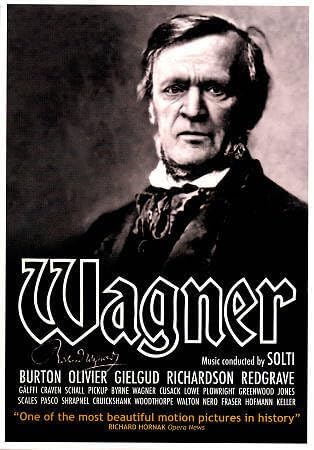
This epic film – described by Richard Hornak in Opera News as “one of the most beautiful motion pictures in history” – was originally made in 1982/3 by Tony Palmer to celebrate the 100th anniversary of Wagner’s death. Filmed in 200 locations throughout Europe, many where the actual historical events took place, with a team from 19 different countries, the entire production was completed in less than a year. Sadly, it was to be Richard Burton’s last major role, but the stellar cast assembled partly because of him includes Laurence Olivier, John Gielgud, Vanessa Redgrave, Ralph Richardson, Franco Nero, Marthe Keller, Gemma Craven, Gwyneth Jones, Peter Hofmann, Arthur Lowe, Ekkehard Schall (Brecht’s son-in-law), Joan Greenwood, Sir William Walton, Gabriel Byrne, Andrew Cruickshank – the list is endless. Multi-Oscar winner Vittorio Storaro & Nic Knowland, the cameramen, produced a stream of astonishing images. And none of it would have been possible without the active and continuous support of Wolfgang Wagner, the composer’s grandson.
Tony Palmer’s 2011 restoration of the 1983 miniseries Wagner is a comprehensive, high-definition, and widescreen edition of the epic film, originally released on DVD in July 2011. The restoration restores the film to its original, full, intended length, spanning over 460 minutes, with the soundtrack featuring Wagner’s music conducted by Sir Georg Solti. We will be showing the work in five parts over the course of 2026 using the 2011 restoration as it was originally edited by Tony Palmer. The music, conducted more-or-less as a favour by Sir Georg Solti, has never sounded better. Storaro’s photography has never looked better. And the script by Charles Wood remains a miracle of historical compression and accuracy, given that Wagner himself was an appalling fantasist and the truth often hard to ascertain.
Part 1 (Episodes 1 & 2) Synopsis
Opening in 1849, Richard Wagner is a respected composer living in Dresden, where he works as royal court conductor for the King of Saxony, Friedrich August II, and he is trying to arrange the first performance of his recently composed opera Lohengrin. Although his wife, Minna, enjoys their life and status, Wagner is bored with his work for the ageing king and spends most of his time writing revolutionary pamphlets against the establishment and aristocracy. Eventually, the May Uprising breaks out and Wagner becomes an important figure behind it. When Saxon and Prussian troops crush the uprising, Wagner becomes a wanted man and is forced to flee to Zürich.
After refusing to join her husband for quite some time, Minna eventually agrees to move to Zürich to be reunited with Wagner. She manages to persuade him to start conducting and composing again and urges him to travel to France. In Bordeaux, Wagner meets a wealthy Scottish emigree, Mrs. Taylor, who agrees to become a patron of his, although he has a brief affair with her married daughter, Jessie Laussot. Upon traveling to Paris, Wagner is ordered to leave the city at once and return to Zürich. In Zürich he meets up with his good friend Franz Liszt, who arranges to perform Wagner’s operas in Germany during his exile. While in Switzerland, he begins his first work on Der Ring des Nibelungen and plans an opera about Wayland the Smith. He also takes on a pupil, Karl Ritter, the son of another patron, Mrs. Ritter.