
SUNDAY 16 AUGUST 2026
THE FUTURE OF OPERA & WHAT WAGNER HAS TO DO WITH IT
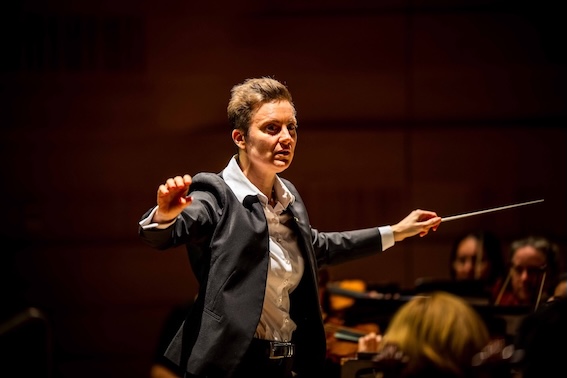
Dr Sarah Penicka-Smith (credit, Keith Saunders)
Sunday 16 August 2026
12.00 noon: DVD – Tony Palmer’s Wagner Part 4
2.00pm: Talk by conductor Dr Sarah Penicka-Smith –
The Future of Opera and What Wagner Has To Do With It
followed by afternoon tea
Venue:
Goethe Institut
Event Hall (upstairs)
90 Ocean Street (cnr Jersey Road)
Woollahra NSW
Tickets:
Members $35, Non-members $45, full-time students $15
Extra viewing/listening for anyone who wants a little more:
– 10 minute documentary on bass-baritone Ryan Speedo Green, joining the LA Phil for ‘Das Rheingold’.
– Two podcast series from Santa Fe Opera: Destination Santa Fe Opera & Key Change
– Santa Fe Opera’s Media page, which includes time-limited audio streams of recent opera performances
– A short teaser for ‘human requiem’, the staged version of Brahms’ Requiem initially performed by Berlin Rundfunkchor,
and recently performed by Orfeo Català in Barcelona.
– And, for a little light reading, Sarah Penicka-Smith’s Churchill Fellowship report,
available for free download (hit the small green ‘download report’ button).
ABOUT THE TALK
Cast your mind back to your first experience of attending an opera. Did you feel welcome? Did you fall in love from the first note? Was it an ‘entry-level’ opera, perhaps a comedy, or was it something generally perceived as being only for connoisseurs?
Much effort is spent these days on how to ensure opera does not become a dying artform. Yet perhaps some of our well-intentioned efforts to create entertaining, easily-understood offerings, for young people or the uninitiated, do our cause more harm than good.
This discussion—in which you will be invited to take part—collects many of the findings from my recent Churchill Fellowship travel to Europe and the USA, beginning with the startling experiences of participants in Santa Fe Opera’s groundbreaking Pueblo Opera Program, which began in 1973 with a production of Der fliegende Holländer. More than fifty years later, the thrill of this experience laid the foundations for three generations of Santa Fe’s Native American communities to attend the opera.
Many of the elements common to the experience of participating in Wagner societies and in Ring festival events emerge as critical to the success of building opera-loving communities. When he created Bayreuth, Wagner provided a model that opera festivals like Santa Fe have developed into modern success stories, a true Gesamtkunstwerk that flows off the stage into the world of human interaction. This talk examines some elements of those successes, with behind-the-scenes glimpses of Santa Fe Opera’s Wagnerian productions along the way.
ABOUT DR SARAH PENICKA-SMITH
Dr Sarah Penicka-Smith is a conductor and socially-engaged artist who made her international debut via The Dallas Opera’s Hart Institute for Women Conductors in 2018. She is currently Associate Conductor of Willoughby Symphony Orchestra.
In 2024, Sarah was awarded a Churchill Fellowship to research socially-engaged orchestral and operatic models internationally, including visits to Santa Fe Opera and the Pueblo Opera Program, Fundación Barenboim-Said, and the West-Eastern Divan Orchestra. She was an inaugural recipient of a residency for socially-engaged artists with The Cad Factory, later joining projects in regional Australia.
Sarah and her wife Melanie Penicka-Smith produce and direct socially-engaged music projects, including commissioning and co-creating ‘OCDiva’, Dr Eve Klein’s one-woman opera for mezzo-soprano and OCD advocate Yasmin Arkinstall. She has directed several Sydney choirs, most recently as the founding Artistic Director & Principal Conductor of River City Voices. She has conducted operas for several Sydney companies, as well as many Sydney orchestras.
In 2026, Sarah’s seven-year collaboration with Italian maestro Carlo Montanaro continues, most recently at the Festival Puccini. She assisted Maestro Nicholas Milton at Göttinger Symphonieorchester for three programs, including two at the Weilburgschlossfestspiele, and in September leads the Willoughby Symphony Orchestra in Mendelssohn’s Lobgesang.
ABOUT THE DVD – TONY PALMER’S WAGNER PART 4
After the failure in Paris, Wagner travels around Europe to Switzerland, Austria and Russia. While looking for financiers for the Ring and Die Meistersinger von Nürnberg, he meets the influential critic Eduard Hanslick in Vienna. He also tries staging Tristan und Isolde in Vienna, but is unsuccessful. Meanwhile, Minna continues to plead with the Dresden court for amnesty for Richard, which is eventually granted. Wagner returns but is chased away when creditors come looking for him. Destitute, Wagner tries to hide but is eventually found by Pfistermeister, personal secretary to the new King of Bavaria, who is desperate to meet him.